California-compliant pressure washer rigs
What the California-compliant Alkota 5357C diesel build is, what the tag covers and what it doesn't, and the questions to settle before you run a rig in California.
Updated October 23, 2026
If you'll run a diesel pressure washer in California, check the engine before flow, tank or price. The California Air Resources Board (CARB) regulates off-road diesel engines, and the engine on a pressure-washer skid is an off-road engine.
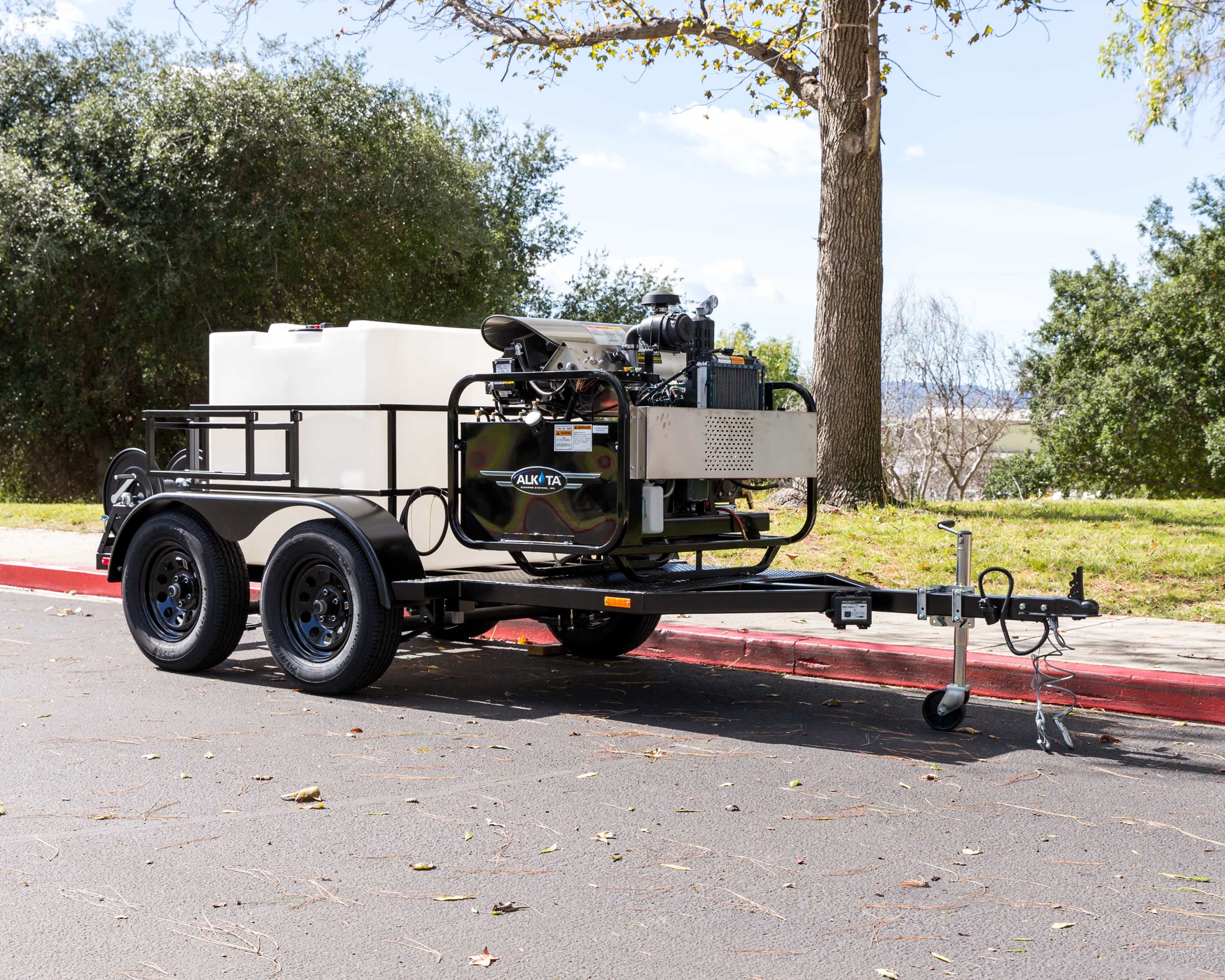
On the Universal Trailer price grid, the build tagged California-compliant is the Alkota 5357C. From its listing:
- 4.7 GPM at 3,500 PSI
- Kubota Z602 water-cooled diesel engine, electric start
- 355,000 BTU burner on a 12V DC system, hot water up to 210°F
- 126 ft of 1/2-inch Schedule 80 heating coil
- GP triplex belt-drive plunger pump with high-pressure chemical metering
- 11-gallon onboard fuel tank and a winterizing valve
- 48 by 34 by 38.5 inches, 845 lb for the machine
It comes on three trailers. On the published grid, the UTS230 single axle with 230 gallons is $19,988, the UTT330 tandem with 330 gallons is $20,428, and the UTT460 tandem with 460 gallons is $21,800. There's no pull-cart version. Freight is free in the continental US, with a fuel surcharge by destination.
Against the 5 GPM AWW-HDS5 on the same trailer, the 5357C costs $5,500 more on the UTS230 ($19,988 against $14,488) and $5,012 more on the UTT460 ($21,800 against $16,788). The money buys the diesel engine the trailer site tags for California and a burner listed for water up to 210°F, at slightly less flow.
The tag is about the engine. It doesn't settle every question a California buyer has, and some of them are local:
- Engine paperwork. Ask the shop for the engine's emissions certification for your file (CARB issues certifications as Executive Orders). If anyone asks you for proof, that's what you show.
- Fleet reporting. CARB's in-use off-road fleet rule, the one with annual reporting, applies to self-propelled off-road diesel vehicles of 25 horsepower or more and to most two-engine vehicles. A washer on a trailer isn't self-propelled. If yours rides on a truck, ask the shop how that rule treats it.
- The burner. A diesel burner makes exhaust too. Whether your air district wants a permit or registration for it, ask the shop to confirm for your county.
- Wash water. Many cities restrict wash water reaching the storm drain. That's a water rule, not an engine rule, and a compliant engine does nothing for it. Reclaim and filtration gear does; ask the shop what your city requires.
Then there are the gas-engine builds. The trailer site tags only the 5357C as California-compliant. The AWW-HDS5, AWW-HDS8, PH5035HBOF and 8405HNL run gas engines (Vanguard, Kärcher and Honda) of 25 horsepower or less, and CARB's small off-road engine rules cover those. Under CARB's 2021 amendments, the smog-forming emission standards for new engines of that kind reach zero by model year 2028. Equipment already built under a valid CARB certification can still be sold, used and repaired. If you're buying a gas build to run in California, ask the shop which engines are certified for sale here now, and have the answer written on the quote. Diesel engines fall outside those small-engine rules.
Outside California the 5357C is simply the diesel option on the grid: one more choice for buyers who prefer a diesel engine. Inside California, start with it, and move to another build only once the shop has confirmed it for use in California.
Tell us what you're cleaning, where in California the rig will run, and who asks you for paperwork. The engine question gets settled first. Use the form below.