Construction site pressure washing: equipment and water
Flow for mud, heat for grease and hydraulic oil, the right chemical for concrete, and a tank big enough for a site with no water.
Updated October 23, 2026
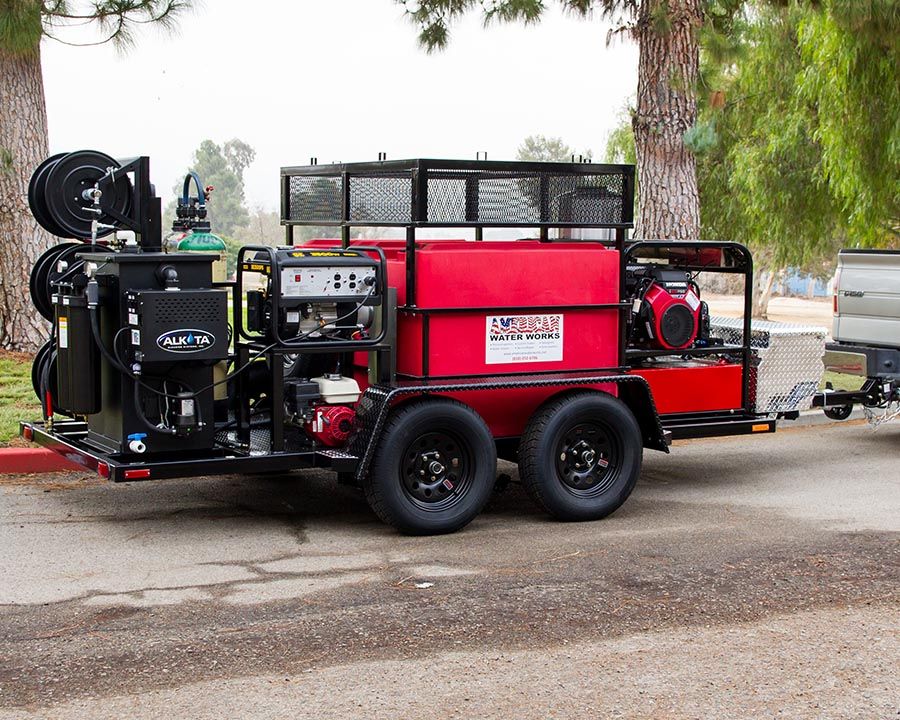
Construction cleaning is two different jobs on the same machine. Mud and clay on tracks, buckets and truck bodies want flow: a high-GPM machine moves it faster than more pressure does. Grease, hydraulic oil and diesel on the same machine want heat. A hot-water machine with real flow covers both, which makes it the usual pick for a site rig.
What usually gets washed:
- Excavators, loaders, skid steers and dozers before service or before they move to the next site
- Dump trucks and concrete trucks
- Concrete forms, panels and tools
- Paving and asphalt equipment
Concrete is the exception to heat and pressure. Fresh splatter rinses off. Cured concrete doesn't wash off with water at any pressure, and blasting at it mostly damages the paint underneath. So wash concrete trucks and forms before it sets: Con-B-Gone, the concrete remover in the Hotsy line, is made for green concrete. For concrete that has already cured, ask the shop. Asphalt and tar are a heat-and-detergent job too.
Water is usually the hard part on a site. Often there's no hydrant you're allowed to open, or the tap is a long way from the equipment. A tank on the trailer fixes that. At full flow, a 460-gallon tank lasts an 8 GPM gun about 57 minutes and a 5 GPM gun about 92. On the published Universal Trailer grid, an 8 GPM AWW-HDS8 on a tandem 460-gallon UTT460 is $18,088, and an Alkota 8405HNL on the same trailer is $20,688.
Watch the weight on dirt. A full 460-gallon tank is about 3,840 pounds of water before the machine and frame, and a soft site road is a bad place to find out your truck is under-rated. The UTT330 and UTT460 run tandem 3,500 lb axles with electric brakes. A 230-gallon single axle is easier to place where the work is, and you refill more often.
In California, the engine is a question of its own. CARB regulates off-road diesel engines. On the Universal Trailer grid, the Alkota 5357C with the Kubota Z602 diesel is the build the trailer site tags California-compliant, from $19,988 on a single-axle trailer. For the gas-engine builds, ask the shop to confirm what applies in your county before you order.
Then the runoff. Wash water off a site carries sediment, oil and concrete fines, and many cities restrict wash water reaching the storm drain. If your site runs under a stormwater plan, ask the plan holder where wash water fits in it. Ask the shop what your city requires, and about reclaim and filtration.
One more thing about mud-only work. If a crew really only washes mud off equipment and never touches grease, a cold-water machine with good flow is cheaper to buy and to run. It's rare on a working site, but it's worth saying on the call.
Tell us what equipment you wash, where on the site, and what water you have. The call sizes the machine and the tank from that. Use the form below.