Fleet washing equipment: what a fleet wash needs
Hot water for road film and grease, enough flow for a line of trucks, water for the yard you wash in, and a plan for the runoff.
Updated October 23, 2026
A fleet wash usually goes wrong in one of two ways. The trucks come back dirty faster than the crew can wash them, or the wash happens so rarely that road film bakes on and needs harsher chemical to come off. Both are usually equipment problems before they're labor problems.
Know what's on the trucks. Road film is oily, and so are diesel soot and the grease around the fifth wheel and chassis. Brake dust collects on the wheels, and construction fleets add mud. Everything on that list but the mud comes off faster with hot water, which is why fleet rigs are usually hot-water machines. Mud wants flow more than heat.
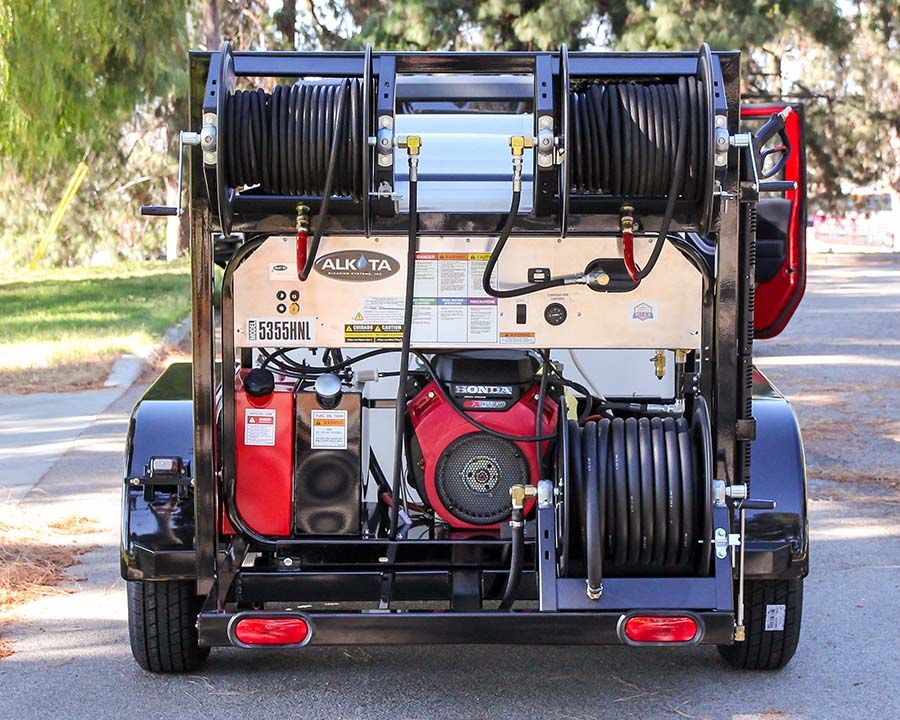
Flow sets the pace. An 8 GPM machine moves 60% more water a minute than a 5 GPM machine at the same pressure, and across a line of tractors and trailers that is the difference you notice. On the published Universal Trailer grid, 8 GPM rigs start at $15,788 for the AWW-HDS8 on a single-axle 230-gallon trailer. If two people wash at once, remember that two guns split the flow: an 8 GPM machine running two guns gives each about 4 GPM, so a two-person crew may want two machines on one trailer.
Then water. If you wash at customers' yards, often after hours, measure what the yard's water supply can deliver before you count on it to feed a commercial machine. A trailer rig brings its own. At full flow, a 460-gallon tank lasts an 8 GPM gun about 57 minutes and a 5 GPM gun about 92. Measure the yard's tap with a bucket and a stopwatch. If it gives 4 GPM and your machine draws 8, the tank drains at 4 GPM and lasts about twice as long, so you can plan the stops.
The usual method is to apply detergent from the bottom of the truck up, so it doesn't streak down a dry panel, give it a minute to work, and rinse from the top down. Hot water lets the detergent work faster, and it keeps the chemical dose down. Ask the shop which Hotsy detergent fits your trucks and your water.
Wash water is the part most new fleet washers find out about late. What runs off a truck carries oil, metals and detergent, and many cities restrict wash water reaching the storm drain. Plan for it before you sign a yard: a containment mat, a vacuum recovery unit, or a reclaim and filtration setup. American Water Works sells water reclaim and filtration, including trailer-mounted recovery builds. Ask your city what it requires, or ask the shop.
If the fleet comes home every night, a fixed wash bay can beat a mobile rig. A stationary hot-water machine can run on natural gas or electric power, with hose drops where the trucks park. Per the manufacturer's 2016 brochures, Hotsy's stationary line included the 1800 series at 6.0 GPM and the 5800 series at 9.5 GPM. A fixed setup like that is quoted on the call, with the power, gas and drain it needs.
What to have ready for the call:
- How many vehicles, what kind, and how often they need washing
- Where you'll wash: your yard, the customer's yard, or a bay
- What water and power are on site
- Where the wash water goes now
Start with the trucks and what's going wrong with the current wash, and the call works back to the machine. Use the form below.