
GPM vs PSI: what actually makes a pressure washer clean faster
Pressure breaks dirt loose and flow carries it off; once the pressure breaks the dirt loose, more GPM is usually what speeds up commercial work.
Updated October 23, 2026
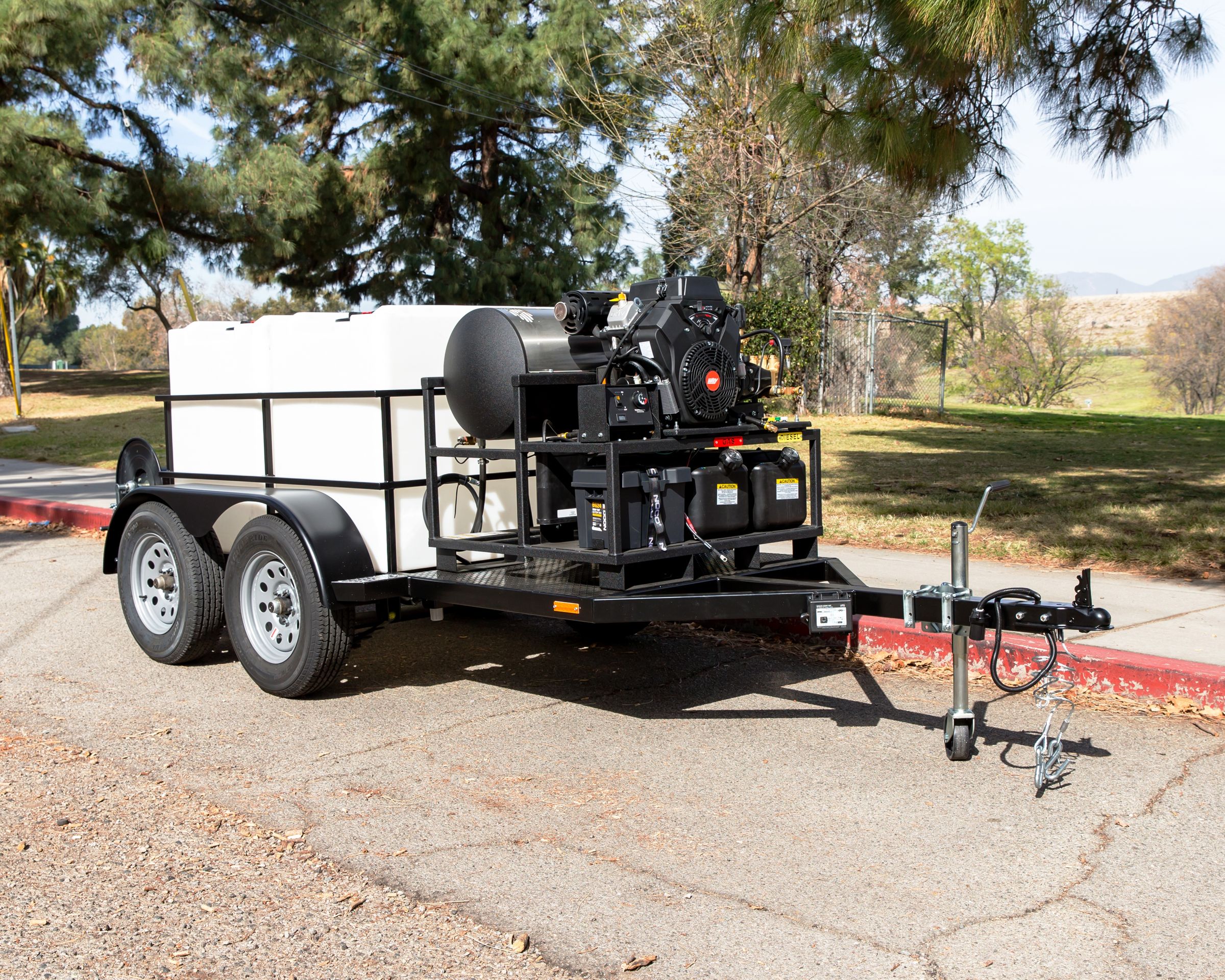
PSI is how hard the water hits. GPM is how much water arrives. Pressure breaks dirt loose; flow carries it away. Most buyers shop on PSI because it's the bigger number on the label, but most of the speed difference between two commercial machines is in the GPM.
The trade uses a rough yardstick called cleaning units: GPM times PSI. A 5 GPM machine at 3,500 PSI is 17,500. An 8 GPM machine at 3,500 PSI is 28,000. Same pressure, 60% more cleaning units, and on a big surface you feel it. It's a yardstick, not a law, but it points the right way: for most commercial work, once the pressure is enough to break the dirt loose, adding flow speeds the job up more than adding pressure.
The motor decides how much of each you can have. Horsepower is shared between pressure and flow, so at a given horsepower you trade one for the other. Per the manufacturer's 2016 brochure, Hotsy's 20 HP stationary machines came as 8.0 GPM at 3,000 PSI (the 5700 series) or 9.5 GPM at 2,500 PSI (the 5800 series). Same motor, about the same cleaning units, spent differently. The 9.5 GPM machine is the one for rinsing big flat areas and heavy mud; the 3,000 PSI one cuts stuck-on dirt a little harder.
On the Universal Trailer rigs the machines are listed at 3,500 PSI (one AWW-HDS8 listing also says 3,000; the shop confirms on the call), so the choice there is mostly flow: 4.7 GPM for the Alkota 5357C, 5 GPM for the AWW-HDS5 and All American PH5035HBOF, 8 GPM for the AWW-HDS8 and Alkota 8405HNL. On a single-axle 230-gallon trailer, the AWW-HDS5 is $14,488 and the AWW-HDS8 is $15,788 on the published grid, a $1,300 step for 60% more water a minute. The same $1,300 gap holds on the tandem 460-gallon trailer, $16,788 against $18,088.
More flow has costs, and they're worth planning for. The first is water. An 8 GPM gun empties a 230-gallon tank in about 29 minutes of trigger time, where a 5 GPM gun takes about 46. If you fill from a hose bib, measure what it actually delivers with a five-gallon bucket and a stopwatch. When the tap gives less than the machine draws, the tank drains at the difference, and you'll want the bigger tank.
The other is heat. Heating one gallon a minute by one degree takes about 500 BTU an hour, so an 8 GPM machine needs a much bigger burner than a 5 GPM one to reach the same temperature. The Alkota 8405HNL uses a 550,000 BTU burner for its 8 GPM and is listed at a 90°F rise over incoming water; the PH5035HBOF uses 315,000 BTU for 5 GPM and is listed at a 115°F rise. More flow, a little less heat.
Pressure still has its place. Gum, cured-on grime and paint prep need impact, and a narrow tip at full pressure gives it. But too much pressure damages surfaces: soft wood, old brick and mortar, vinyl, decals and paint all etch or lift. The nozzle matters as much as the machine's rating. Each machine needs tips sized to its flow and pressure, and a worn or wrong-size tip drops pressure or overloads the pump.
Rules of thumb from the counter:
- Flatwork with a surface cleaner, fleet rinsing and mud: buy flow.
- Gum, stuck-on grime and paint prep: pressure matters, and 3,000 to 3,500 PSI covers it.
- Two guns on one machine split the flow. An 8 GPM machine running two guns gives each about 4 GPM.
- Old masonry, wood and painted surfaces: heat and detergent at low pressure, with a wide tip.
Tell us what you clean, how big the surfaces are and where the water comes from. That's enough to size flow and pressure on the first call. Use the form below.