Municipal pressure washing equipment
One hot-water rig can serve several departments; graffiti needs its own truck, wash water needs a plan, and a bid file needs a written spec.
Updated October 23, 2026
A city's washing is spread across departments that rarely buy together. Fleet maintenance washes trucks and buses. Streets and parks crews clean sidewalks, plazas, restrooms and park furniture. Facilities handles parking structures and building exteriors. Another crew handles graffiti. Most of that list is hot-water work, and much of it happens where there's no tap to hook up to.
One trailer rig can serve more than one department. A hot-water machine on a tandem trailer with a 460-gallon tank washes a refuse truck in the morning and a plaza in the afternoon. More hose reels let two people work from one trailer, as long as the machine has the flow to split between two guns: an 8 GPM machine gives each gun about 4 GPM. On the published Universal Trailer grid, tandem 460-gallon rigs run from $16,788 for the 5 GPM AWW-HDS5 to $21,800 for the Alkota 5357C Kubota diesel, the build the trailer site tags California-compliant.
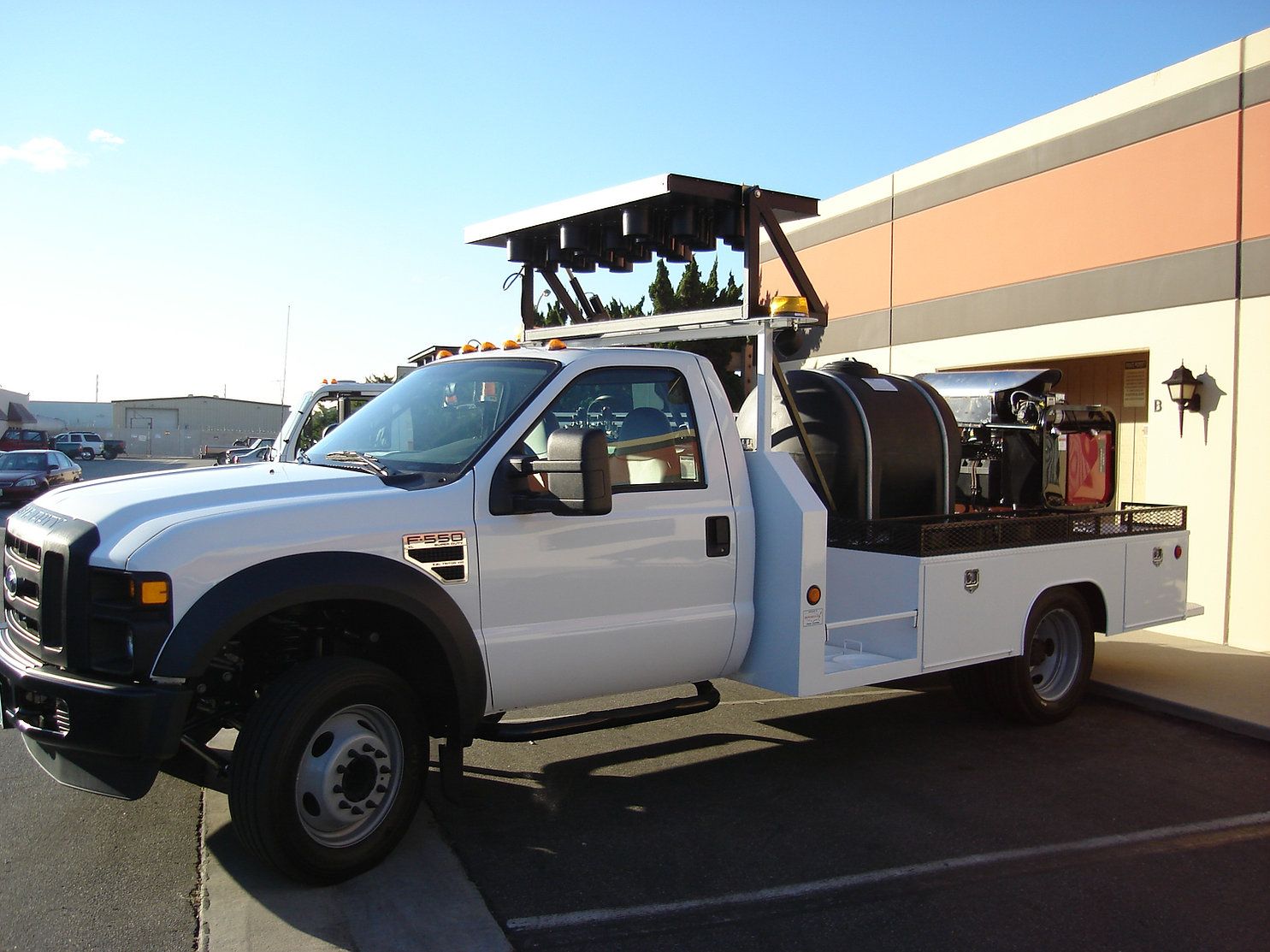
Graffiti is its own tool. The Roadline graffiti-removal truck, model GPMT-H/W, carries hydraulic airless paint systems for painting over what won't come off, and a heated high-pressure wash system is an option. Per Roadline Products' flyer, it comes standard with one complete airless paint system (up to six can be fitted), a 12 GPM hydraulic pump, a removable paint tray and gun holster, a below-deck toolbox, traffic-cone storage and a paint well for seven 5-gallon containers. Options include the wash system, more paint systems, electric hose reels, an arrow board, rotating lights, work lights for night work and a sodium cleaning system. It's quoted on the call.
Pressure needs judgment on public surfaces. Old brick, carved stone, monuments and painted metal etch or lose finish under a narrow tip at 3,500 PSI. Heat and the right detergent at low pressure, with a wide tip, are the place to start; test a small area first, because even gentle washing can harm old masonry. Sidewalks and plazas are the opposite: gum and grease want heat, and a surface cleaner wants flow.
Wash water is a question for a city crew too, because many cities restrict wash water reaching the storm drain. What comes off a plaza or a refuse truck carries grease, metals and detergent. A vacuum recovery unit or a reclaim and filtration setup keeps it out of the drain, and American Water Works sells both, including trailer-mounted builds. Ask your stormwater program, or ask the shop, what your permit requires.
For the bid file, ask for a written quote with the full spec, the manufacturer's brochure and the warranty terms. The rig prices are published, which makes a budget line easy to write before the quote arrives. Rigs ship free in the continental US with a fuel surcharge by destination.
For repairs, the Pacoima shop's service trucks work Los Angeles, Orange and Ventura counties and repair Hotsy, Alkota and All American machines and other makes. In the Carolinas, call the Conway shop and ask what can be serviced locally.
Tell us which departments would share the equipment, what they clean, and where the wash water goes now. Use the form below.