Starting a mobile pressure washing business: the equipment side
Pick the work first, then the machine; know the real cost of a rig, how financing and ordering work, and which local rules to check before your first job.
Updated October 23, 2026
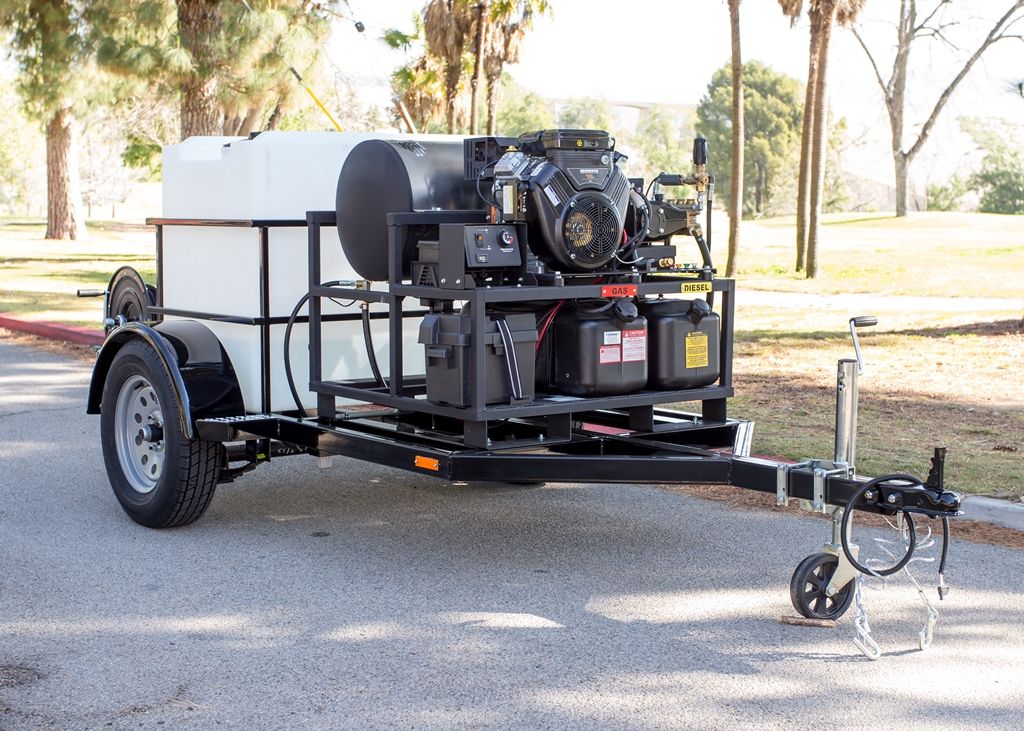
Pick the work before you pick the machine. Residential flatwork, commercial property, restaurants and fleet washing need different equipment, and a rig bought for the wrong work is the expensive mistake. If you'll wash anything greasy (restaurants, trucks, gas stations, dumpster pads), you need hot water. If it's mostly houses, decks and driveways, a cold-water machine with good flow can be enough to start, and you can add heat when the work calls for it.
Then size the flow to the work. A larger surface cleaner and long rinses want more GPM. On the Universal Trailer rigs the machines are listed at 3,500 PSI, and flow runs from 4.7 to 8 GPM. On the published grid, the entry rig is the 5 GPM AWW-HDS5 at $14,488 on a single-axle 230-gallon trailer. The 8 GPM AWW-HDS8 on the same trailer is $15,788, which is $1,300 more for 60% more water a minute. If you're planning commercial work, that's usually the better place to stretch than a bigger tank.
The rig isn't the whole cost. Budget for:
- A truck rated to tow the loaded trailer. A full 230-gallon tank is about 1,920 pounds of water before the machine and frame.
- A surface cleaner, spare tips, extra hose and a basic parts kit
- Detergent for the work you'll do
- Fuel. A hot-water machine burns fuel for the engine and the burner; the All American PH5035HBOF's burner is listed at 2.25 gallons of diesel an hour, plus gasoline for the engine
- Liability insurance and a local business license
- Wash-water recovery if your city requires it
Check the local rules before your first commercial job, not after. Many cities restrict wash water reaching the storm drain. Ask your city what it requires, and ask the shop about recovery gear if it does.
How ordering works. No payment is taken online. The shop confirms the spec, sends an invoice, and starts building once it's paid. Freight is free to anywhere in the continental US, with a fuel surcharge by destination. Each rig is built to order and can't be returned, so settle the spec on the call.
Financing is through outside lenders. American Water Works finances through Lease Consultants, and the trailer site also names Apex Financial. AWW's leasing page says typical leases need one or two months' payments as a deposit. A business without much history may see different terms, and everything is subject to credit approval; the financing page has the details.
A used machine can be a sensible start. The shop takes trade-ins and lists refurbished units on the used equipment page when it has them.
Look after the machine and it keeps working. Hard water scales a heating coil over time, freezing water cracks pumps and coils (the Alkota 5357C has a winterizing valve for that reason), and a pump runs longer on clean inlet water and regular oil changes. The Pacoima shop repairs what it sells, and other makes.
Growing usually means a second gun, more hose reels, or a second machine on the trailer, so leave room on the deck and in the plan.
Tell us what kind of work you want to take on and what you'll tow with. The first call is about the business you're building, then the rig. Use the form below.